Article Overview:
Introduction
Trending Content or Evergreen Content?
This essential question is top of mind for many brands, content creators, and marketing strategists in 2025.
In an era where content is the backbone of brand-audience communication, deciding whether evergreen content or trending content can better drive engagement, impact, and trust has become a strategic priority.
Trending content acts like a wave—attracting lots of attention and short-term traffic, but quickly fading away. In contrast, evergreen content is like deep roots—steady, long-lasting, and continuously valuable over time.
In this article, we take a close look at the key differences, benefits, challenges, and selection criteria between trending and evergreen content.
By comparing the structure, function, and goals of each approach—and offering a golden formula for building a smart content strategy in 2025—we’ll help you map out the best path for your brand.
Your guide to designing a smart content strategy for 2025 starts here!
If you want to discover how the right mix of evergreen and trending content can guarantee your brand’s success and attract loyal audiences through both real-time engagement and long-term value, don’t miss the rest of this article!
Trending Content
Trending content is content born from fleeting cultural, news, or social waves—created for the moment, captivating now, but rarely lasting into tomorrow.
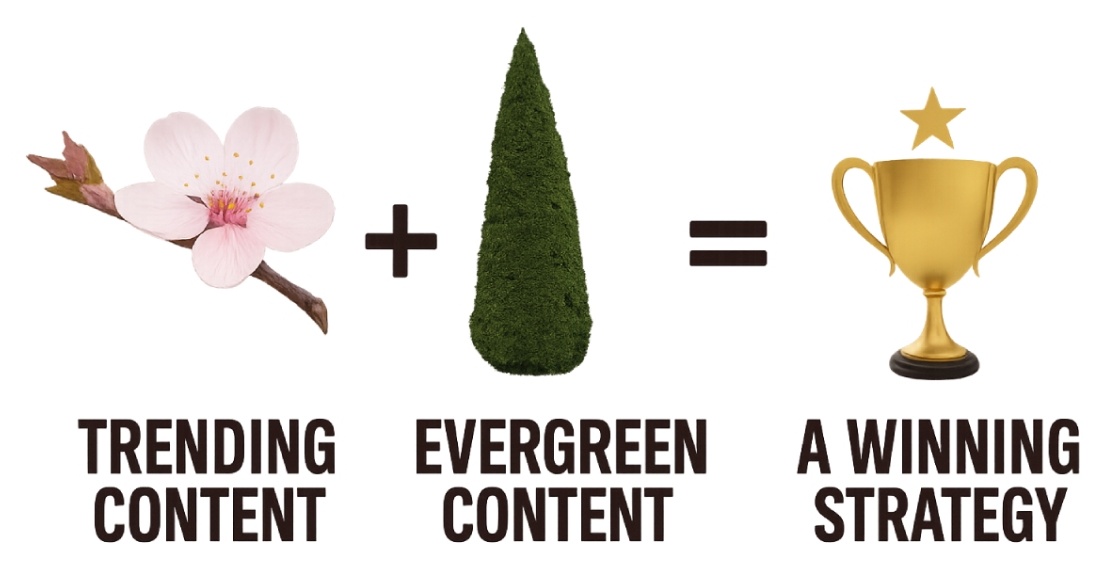
Trending content is like a blossom:
Beautiful, short-lived, and attention-grabbing. Just like spring flowers, it blooms at its peak, catches everyone’s eye, but its life is brief and it falls away with the first breeze.
Or it’s like a bright flame:
Warm, illuminating, and sparking curiosity—but only for a short while.
It shines intensely, but fades just as quickly.
This type of content typically revolves around current events, hot news, special occasions, or social media trends. It has high potential for real-time engagement and can quickly go viral. However, its value is time-sensitive; what’s viral today will likely be forgotten tomorrow

Key Characteristics of Trending Content
Trending content is specifically designed to ride a wave of public attention—a wave that typically rises quickly and fades just as fast.
Here are five main features of trending content:
Examples of Trending Content
Trending content usually focuses on topics that, during specific time periods, strongly capture the audience’s attention and spark widespread discussion. These topics may arise from economic or social events, or stem from cultural, technological, and lifestyle trends
Here are some common examples of topics around which trending content is created:
In 2025, trending content is often delivered as short-form videos on platforms like TikTok, Instagram Reels, and YouTube Shorts, maximizing real-time engagement and viral potential as part of a smart content strategy.
Evergreen Content
Evergreen content is like a cypress tree in the digital world—strong, lasting, and beautiful in every season.
While trending content comes and goes, evergreen content remains consistently useful, reliable, and valuable—today, tomorrow, and beyond.
If you want to learn more about the full definition, benefits, and production methods of this type of content, don’t miss our dedicated blog post: Evergreen Content:
Comparing Trending Content and Evergreen Content
Evergreen content and trending content are two sides of the same coin in social media strategies. Understanding the difference between them helps brands create a smart mix to attract audiences and maintain engagement. Trending or seasonal content stands in stark contrast to evergreen content. Trending content is like a bright but short-lived flame; it quickly grabs attention on social media, but fades away just as fast.
While trending content can generate instant and temporary attention, evergreen content serves as a lasting source of information and can drive sustained traffic and value for social media channels over a long period.
Recognizing the key differences between these two types of content enables you to design a balanced and intelligent content strategy based on your brand’s needs, available resources, and short- or long-term goals.
The following table highlights the most important distinctions between trending and evergreen content. This table has been developed by the Bazarneto content team, drawing on field analysis, project experience, and the latest research in content marketing:
Comparison Criteria | Evergreen Content | Trending Content |
Main Goal | Building trust and turning the audience into loyal customers | Quickly attracting attention and increasing real-time engagement |
Lifespan | Months to years | A few hours up to a maximum of one week |
Production Cost | Requires in-depth research and a solid structure | Often quick and based on visual creativity |
Return on Investment | Long-term (6 months to 2 years) | Short-term (1 to 4 weeks) |
Traffic Generation | Attracts steady and consistent traffic | May attract high traffic in the short term, but this traffic is short-lived |
Updating | Needs less frequent updates, but can be kept fresh by adding new information | Requires constant updating to stay aligned with new trends |
Engagement Rate | Continuous and steady engagement (likes, comments, shares) | High short-term engagement, but likely to drop off quickly |
Brand Impact Stability | Builds and enhances brand awareness, credibility, and identity | Has a short-term impact on the brand and may require continuous new content |
Target Audience | Users searching for sustainable solutions (e.g., business managers) | Users following current trends and daily entertainment |
Best Platforms | LinkedIn, blogs, YouTube (basic tutorials) | TikTok, Instagram (Stories, Reels), Twitter (trending hashtags) |
Examples on Platforms | LinkedIn: Article “Time Management Principles for Entrepreneurs” | Twitter: Tweet about “Top Movies of 2025” |
Comparison of Trending Content and Evergreen Content
Prepared by the Bazarneto Content Team
Conclusion
Which Type of Content Is Best for Your Brand? (What we learned!)
Striking the right balance between evergreen content and trending content is one of the core principles of a successful digital marketing strategy.
A smart combination of both—especially with the recommended ratio of 80% evergreen content and 20% trending content—can ensure your brand’s long-term stability while also maintaining real-time audience engagement. Of course, this ratio should be adjusted based on your specific goals. If you are in a growth phase and want to attract new followers, you can lean more towards trending content. If your main objective is to build a comprehensive content archive for long-term SEO, evergreen content should be your focus.
Evergreen content acts like the roots of a tree, forming the solid foundation of your brand building. In contrast, trending content is like seasonal blossoms, offering the opportunity for quick and reactive engagement with your audience.
In today’s dynamic world, these two types of content complement each other—they are not substitutes.
Focusing solely on one type can present challenges for your brand. While trending content drives high engagement and quick visibility, its lifespan is short and it quickly fades from attention. Producing it continuously also requires significant resources and responsiveness, and sometimes it can dilute your brand message. On the other hand, evergreen content is stable and deep, but requires regular updates and creative refreshes, and may not be as effective for immediate audience acquisition.
Choosing between trending and evergreen content depends on your brand’s goals, available resources, and desired level of engagement!
You can even develop trending content based on evergreen topics. Otherwise, you’re left with content that is quickly forgotten by both your audience and search engines.
If you rely only on trending content, your brand will be forgotten as trends change. If you stick only to evergreen content, you’ll miss out on live conversations with your audience.
So what’s the solution?
Build a smart bridge between the two! For example, execute seasonal trends based on evergreen concepts; this way, you remain responsive while also building long-term effectiveness.
Use evergreen content to build long-term brand credibility.
Use trending content to boost short-term engagement, visibility, and active participation in current conversations.
For a sustainable strategy, connect these two content types—don’t separate them.
Now It’s Your Turn!
Review your brand’s
content strategy
Have you established a proper balance between evergreen content and trending content? If not, take a step today
- Read this article!
- Consult with Bazarneto so we can help you design your brand’s content strategy based on your goals, resources, and audience.
Article writer

Mehrnoosh Choobandian
Director of Bazarento
Ph.D. in Marketing
Marketing & Branding Strategist
Want Your Content to Stay Relevant and Perform Long-Term?
Whether you're after trending content or evergreen strategies, Bazarento's content experts are here to help you craft high-performing content that truly connects with your audience.
“Great insights! I’ve always struggled to find the right balance between trending and evergreen content. This article really helped me see how both can work together.”